
The cost of health insurance is a large component of retirement-related decision-making. If you’ve paid into Social Security over the years, your Medicare Part A or hospital insurance is likely covered. But Medicare Part B, which is standard medical insurance for doctor visits and regular outpatient needs, comes with a monthly premium.
The standard Medicare Part B premium in 2025 is $185.00. The standard Medicare Part B beneficiary continues to pay approximately 25% of the coverage cost, with the government covering the remaining 75%.
Premiums move in correlation with inflation rates. In 2025, the standard premium increased by $10.30 from 2024. For this reason, even if you are paying the standard rate, your premium will fluctuate over time.
Is Medicare Tied To Social Security?
Medicare and Social Security are both federally sponsored programs. When you begin collecting Social Security, you are automatically enrolled into Medicare. But starting your Social Security benefit is not required to receive Medicare benefits.
While the two programs often go hand in hand with retirement, they are separate programs. One way they are tied is that the Social Security Administration (SSA) calculates your Medicare premium amount.
Premium Determination: The SSA determines your Medicare Part B and Part D premiums, particularly if you are subject to the Income-Related Monthly Adjustment Amount (IRMAA). This determination is based on your Modified Adjusted Gross Income (MAGI) from two years prior, as reported to the IRS. Meaning premiums for 2025 are based on your 2023 tax return.
Premium Payment: If you receive Social Security benefits, your Medicare premiums are typically deducted directly from your monthly Social Security payments. This streamlined process links the two programs operationally.
Higher Than Standard Medicare Part B Premiums
So why may you receive a higher premium than the current standard rate? High-income earners can fall into a category of the population charged higher premiums for Medicare Part B.
SSA conducts a 2-year look-back into your tax returns to determine your Medicare premiums. This means 2025 premiums are based on your 2023 tax return.
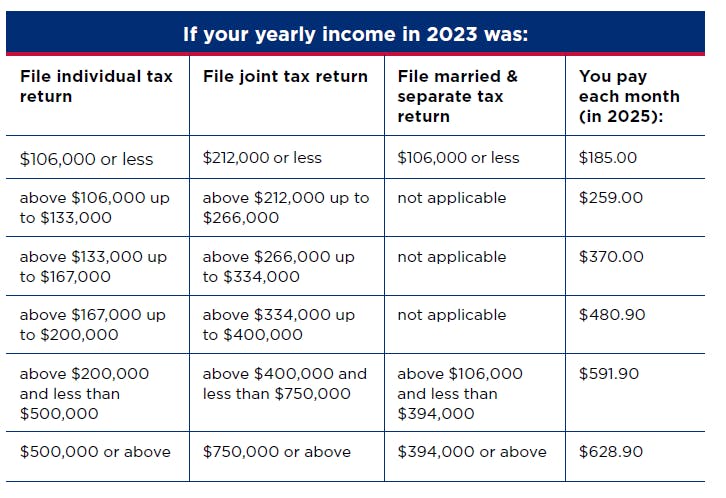
Those paying the standard rate are paying approximately 25% of their plan’s premium costs; Medicare covers the other 75%. High-income earners will pay monthly Part B premiums equal to 35, 50, 65, 80, or 85 percent of the total cost, depending on your income. This same scenario also impacts prescription drug coverage. In 2025, the income brackets for higher Part B premiums start at a MAGI of $106,000 for single tax filers and $212,000 for joint filers.
For example, individuals using a filing status of single with a MAGI between $106,001 and $133,000 will pay $259.00 per month for Part B. Certainly a bump from the standard $185.00 per month.
What About Medicare Part A?
The average retiree is covered 100% in Medicare Part A through the federal government, meaning there are no premiums to receive hospital care.
But there is a portion of the population that does not qualify for this benefit because they have not paid enough into the system. Those who have not worked at least 40 quarters will be charged a premium for Medicare Part A.
The following figures are guidelines for what one can expect to pay if they haven’t worked 40 quarters. In 2025, those with 30-39 quarters pay $285 per month for Medicare Part A, and those with less than 30 quarters pay $518 per month. If you are leaving the workforce by choice, these are important figures to take into consideration.
Can You Appeal Higher Premiums?
Yes, you can appeal higher Medicare premiums. Significant life changes will be considered, and your premium may be reduced if you can provide proper justification. Loss of income, change in marital status, or changes in a pension plan are all examples of situations where you are encouraged to appeal your premiums. Beware, just because you have a large capital gain or a large IRA distribution in one year and these will not occur again, the SSA will not accept these one time events as a reason to reduce your Medicare Part B premium as they do for other changes.
These reasons are not all-encompassing, nor can we guarantee a favorable adjustment. But it is important to understand your rights so you are not overpaying in these often unforeseen circumstances.
Social Security has an online portal where you can submit an appeal along with supporting documentation for review. If you prefer to submit your appeal in writing, this option is also available. You can print and mail the appropriate forms or obtain them from your local Social Security office.
It’s important to note, your premium is based on your Modified Adjusted Gross Income (MAGI). If your dispute is related to your MAGI being overstated, the correction will need to be made with the IRS before Social Security can review.
Stuck With Higher Premiums? What To Do Next
If you find yourself paying higher than the standard premiums, meeting with a wealth management professional is well worth your time. Creating an all-encompassing financial plan that helps you minimize your tax burden is no easy feat.
We welcome you to review our services at Foundation Wealth Management with offices in Media, Pennsylvania, Wilmington & Rehoboth Beach, Delaware. We serve people like you all across the country. A few things we want you to know:
- We operate as fiduciaries — we put your best interest in front of our own.
- We are an independently owned, fee-only organization.
- Transparency is the name of the game at Foundation Wealth Management. We’d be honored to earn your trust.
We invite you to schedule an introduction call to learn more about our services and investment philosophies. We look forward to meeting you.
About Foundation Wealth Management
Foundation Wealth Management is a CPA-led organization, that provides financial planning services and tax planning support; services and outcomes vary based on each client’s circumstances. Our team includes qualified professionals, such as CPAs and CFP®s, who are integral to our service offerings. Our team includes 3 Certified Financial Planners: Burt Hutchinson, CPA, CFP®, Paul LaViola, CFP®, and Stephen McDade, CFP®.
As Fee-Only planners, we are compensated directly by clients rather than through commissions from brokerage or insurance products, which we believe helps align our services with client goals.
Sources:
- https://www.cms.gov/newsroom/fact-sheets/2025-medicare-parts-b-premiums-and-deductibles
- https://www.kiplinger.com/retirement/medicare/medicare-premiums-2025-irmaa-for-parts-b-and-d
Disclosure Statement:
This presentation is not an offer or a solicitation to buy or sell securities. The information contained in this presentation has been compiled from third-party sources and is believed to be reliable; however, its accuracy is not guaranteed and should not be relied upon in any way whatsoever. This presentation may not be construed as investment, tax, or legal advice and does not give investment recommendations. Any opinion included in this report constitutes our judgment as of the date of this report and is subject to change without notice. All investments are subject to risk, including the possible loss of principal.
Additional information, including management fees and expenses, is provided on our Form ADV Part 2 available upon request or at the SEC’s Investment Adviser Public Disclosure website, Past performance is not a guarantee of future results.